
The History -
Dr. Maria Montessori
- A Life - Highly Inspirational
Dr. Maria Montessori was the first woman to practice medicine in Italy. A scholar of biology, psychiatry, anthropology, and medicine, she graduated from the Faculty of Medicine at the University of Rome in 1896. As a physician, Dr. Montessori was in touch with young children and became profoundly interested in their development. Through careful and exhaustive scrutiny, she realized that children construct their own personalities as they interact with their environment. She also observed the way they learned as they spontaneously chose and worked independently with the materials she provided.
1896-1907
Dr. Maria Montessori’s work brings her into close contact with children. Institution was dedicated to the care and education of youngsters that were considered “cognitively challenged”. Through the development of her Montessori method, many of these 8-year-old students are able to pass standard testing with above-average scores.
1907
Dr. Maria Montessori opens Casa dei Bambini or “Children’s House,” for children ages 3 to 6 years in one of the poorest neighborhoods in San Lorenzo, Italy.
1907-1945
Word of Dr. Montessori’s successes spread to public figures, educators, and journalists. By 1910, schools using her methods had opened throughout Europe, and were being opened around the world. She lectured widely, wrote articles and books, and developed a program to prepare teachers in the Montessori Method.
1940-1945 she was in India
1946-1952
Returning to Europe after the war ended, Maria spent the rest of her days in Amsterdam. She died peacefully on May 6, 1952.
1911
The year was 1911. A young man set up practice as a District Pleader in Vadhwan Camp, in the erstwhile princely state of Bhavnagar in Saurashtra. His practice was doing well, he was gaining a name and earning too, but his heart was not in the machinations of legal matters.
1913
In 1913, he became a father to a son. The advent of the child Narendra triggered the life mission which would launch him into a new role. The man was Gijubhai Badheka and his mission was to bring about a revolution in the field of child development and education.
Gijubhai was born as Girjashankar Bhagwanjibhai Badheka on 15 November 1885 in Vallabhipur (Vallabhi) or Vala ( In the Saurashtra region of western India) In 1907, he moved to East Africa and later, Bombay for work. Badheka died on 23 June 1939 in Bhavnagar, India.
In 1915, Gijubhai helped to frame the constitution of an educational institution in Bhavnagar called Dakshinamurti.
Dakshinamurti Balmandi
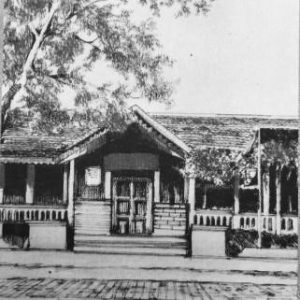
The Balshala at Kala Garnala
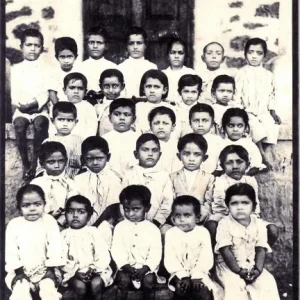
The first batch of Balmandir children 1921-22
He played a vital role in shaping child-centred education in India. Deeply influenced by the work of Maria Montessori, Gijubhai adapted Montessori principles to suit the Indian cultural and social context.
Tarabai Modak is rightly called as the “Montessori Mother”. She has made a significant contribution to preschool education in India. Her method brought in a silent revolution in the tribal community of Kosbad.
Padma Bhushan Tarabai Modak, a pioneer of preschool education in India was born in April 1892. She graduated from the University of Mumbai. In 1921, she became the first Indian principal of Barten female college of Education at Rajkot.
In 1923, she resigned from college and joined Shri Gijubhai Badheka who conducted a pre-primary school in Bhavnagar and propagated Montessori’s theories. In 1926, she helped him establish the Nutan Bal Shikshan Sangh for the spread and development of pre-primary school and teacher training center in Dadar in north Bombay.
She started the Gram Bal Shiksha Kendra at Bordi in 1945. In 1957 she shifted Gram Shiksha Kendra from Bordi to Kosbad. The Vikaswadi Project was launched and conducted at Kosbad under her constant guidance. She devoted the last 27 years of her life to this project which was the core of Gram Bal Shiksha Kendra’s activities. She was the General Secretary of Nutan Bal Shikshan Sangh for over 25 years and subsequently became its Vice president. She wrote a number of books for children and parents in Marathi and Gujarati. She also wrote books on child education in English. In 1962, the Government of India honoured her with the title of Padma Bhushan.
She passed away on 31 August 1973 at the age of 81.